Pinning Inspiration

When I recently saw a ficus leaf mineral thru an electron microscope on pinterest, it reminded me of this piece from about 15 years ago. When I made it, I’d never seen a ficus leaf mineral, but I love how interrelated so many forms and patterns of nature appear to be, whether you’ve ever seen them to influence you or not.

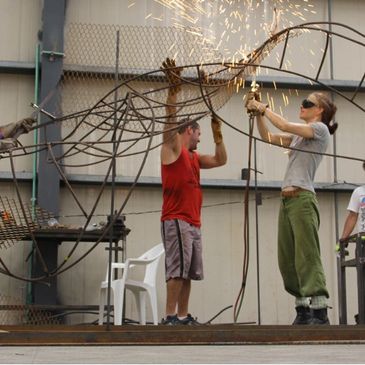
Catching Glimpses in the Gloaming, 1998. Crocheted copper wire, cast silver dogwood blossoms, fake eyelashes, fake fur, steel wire. Photo Courtney Frisse

“I can’t even look at it,” ran through my head whenever I would see the little pin it icon. “Pinterest is going to distract me from important things.”

But now I’m coalescing Nature Patterns onto a digital board that kind of tweaks the in-love chemistry in my brain.  Pinning before bed has catalyzed beautiful, vivid dreams; something about the free associative process of following this intricate thread of visual networks is soothing while stimulating creativity. To be able to float through images, seeing some things I never knew existed in the world, is like cranking the amperage on curiosity and getting a fascination fix.

Every time I pin onto this board, I’m adding inspirational matter for future Living Sea Sculptures.  As I gravitate towards images, I see a collage emerging; it’s a valuable personal palette made from the communal well of web surfing and discovery.  Microscopic bacteria, bike chains, textiles, lava flows, and biology on land and sea reflect and imitate each other as they assemble into rivulets, orbs, bumps and repetitions. Physical forces, changing pressure and process has resulted in these…these moments captured in photographs and stills.  Somehow there is motion and color telling a story, a lifelong history embedded in the pictures, and that wordless-ness attracts and suggests new models for ocean habitat.

Sculptural porcelain by Nuala O'Donovanj

giant snail invasion

Giant African Land Snail 1
Brian – pet Giant African Land Snail. photo by C. Rayz

I got an email yesterday: “I came across this article and thought it might be an interesting opportunity for Miss Snail Pail.”   Thanks, Dave!

Florida Battles Slimy Invasion by Giant Snails

Next thing I know, I’m writing to Denise Feiber, the spokeswoman for the Florida Department of Agriculture and Consumer Services to offer help with a solution.  Collection has already been very successful according to this document, Officials Praise Public for Helping Battle… , “Tens of thousands of giant African land snails have been captured since the massive mollusk was discovered in Miami-Dade County on September 8 and Florida agricultural officials credit public vigilance for the bulk of the captures.”  Great news that everyone is working together. What happens to the snails once they are collected?  Are they being eaten?

People from Africa to Europe to the US recognize that snails are a nutritious food source. Destroying them is a waste of protein rich harvest.  If the goal in Florida is to eradicate a stucco-eating, plant devouring invasive land mollusk, then poisoning them with crustacean and bee-killing toxins (poisons don’t discriminate), will effectively poison ourselves and all organisms indefinitely and with unknown consequences. People are hungry and eat all kinds of weird crap. Go to a fast food chain or look down your grocery aisles. So many processed items and chemicals on display, we forget that an infestation like this is an opportunity to do something sane and proven: hunt and eat this micro-livestock into “local extinction” like humans are known to do all over the world.

The article, perhaps unconsciously, demonizes the snail as though it is a disease ridden monster victimizing the hapless human community.  Surely other species have some things they’d like to say about our habits and microbes if they could get their words on the page. Florida is facing a real problem and I WISH I had been at the symposium last week where they were trying to determine the plan of action. I’d like to be hired to lead the GAS (giant african snail) Task Force: a consortium of homeowners, restaurateurs, snail expeditioners… to organize a system to bring the environment into balance in a bountiful way.  If it took 10 years to eradicate the last infestation of 1966, I think by bringing them onto the table, we can reduce that time frame.

Oysters are endangered because of human consumption and pollution, so with that as proof of concept, seems hungry people can get a handle on this misnomered delicacy. And about the parasites, wear gloves and cook them. Cows and chickens have parasites too, and people know better than to eat raw coq au vin. If you’re interested in launching some snailing expeditions and organizing an event to celebrate that a prolific, valuable species is offering its life as a resource, contact me.

The hypocrisy of letting people starve or be malnourished while deeming the arrival of a massive mollusk a disaster illustrates how far removed many humans are from the food chain and creating environmental balance with available resources.
I’m anti-extinction, unless we’re talking about polio, malaria, West Nile Virus (I have some bias), and interpret this infestation as a migration of herds of shelled cattle across the seas.
It all boils down to respecting and honoring life cycles. The snails are not the enemy.

“Why DeExtinction makes me nervous.”

Creative Conservationist, Asher Jay, expresses her reaction.

Why DeExtinction makes me nervous:

I take issue with nature becoming a subset of artifice. Ecosystems worldwide are already extensively curated by man, and that has resulted in few positive outcomes, if any. When you zoom out to see the larger picture, every human invention and intervention has resulted in a Black Swan*. This process of “regenesis” is not only expensive, but in its highly volatile, inchoate stages has no credibility as a sustainable solution; its potential is solely in one’s vivid imagination. Would it not be wiser to acknowledge what damage we have done and attempt to conserve what remains? In a world devoid of the common sense and compassion it takes to preserve dwindling counts of mega fauna should we really attempt to revive those we have driven to eternal silence through an imperfect procedure that has only resulted in death so far? What value does such a technology place on “life”? What of the lives lost during trial and error as science experiments? At present naturally conceived, sentient mammals that make for great cuddle toys, are not afforded the right to exist outside the spectrum of commercial exploitation, what duties of justice will the offspring of synthetic biology be granted?

We subscribe to economies of scale, we have yet to shed this avaricious mentality. Today, a select few have access to this technology; they are idealistic and intend to harbor long discussions about ethical implementation strategies before they actually set the ball in motion, but over time, this will be replicated by others and the competition will result in some using it for the right reasons and yet others for terribly wrong ones. This will likely diminish the worth of life as demand levels the costs, which would render these living beings as mere replaceable commodities- seeding large scale factory farms for harvest or worse yet as lab rats for other purposes!

Let’s flip the coin for a minute, what if they did succeed at bringing back an animal? So they spend all this money to re-wild a species for which they believe a context still exists, and once introduced into its habitat, it chokes on plastic litter, gets fried on power lines, consumes a poisoned pest, or falls prey to a poacher’s trap? Or it lacks a vital skill it would have learned only from the time it was meant to live in, from its natural parents, social systems and environment, so it fails to survive anyway? Not to mention the fact they could serve as vectors for pathogens? How much are we willing to gamble to create something with no guarantees, when we haven’t the intelligence to allocate resources to conserve what remains now? The more sensible route would be to fix our broken system and address the underlying causes that have resulted in extinctions during the Anthropocene, yes?

I think they should use this money to buy up land, build infrastructure for impoverished communities to ameliorate human-animal conflict areas and protect habitat range. They could hire anti-poaching squadrons, employ drones and trap cams, radio tag critically endangered animals and channel only surplus funds toward this recreational effort. Extinction is a natural process that has been an implicit part of the terrestrial narrative, for over 3.8 billion years, to thwart it only underscores human hubris. I am, however, not against their agenda to introduce genetic diversity to those species with fallen numbers through artificial insemination, as this measure will help ensure their survival, but to do anything more would be folly. Also do bear in mind that we have not successfully sequenced an entire genome thus far, so to splice, dice and swap bits of genetic material without knowing everything about its entire length is pretty darn foolish.

We are rather frightening in our ability to linger in denial and expend significant assets towards hyped agendas that have no proven track record to take comfort in; we do this because we are too afraid to admit to our shortcomings and past failures. Instead of being introspective and encouraging spiritual evolution we constantly look to the external and try to realign the physical, which is always out of sync with the pulse of the planet.

The Earth has known about life and death since its humble beginnings, to assume we know more and can do one better spells nothing but arrogance in my book.

——————————————————-
*Black Swan by Nassim Nicholas Taleb deliberates that rare and improbable events do occur much more than we dare to think. Our thinking usually is limited in scope and we make assumptions based on what we see, know, and assume. Reality, however, is much more complicated and unpredictable than we think. Also, assumptions relevant to average situations are less relevant to irregular situations, especially when the “rules of the game” themselves do change.

De-Extinction: Bringing Back the Dead

“I like how Plum has turned you into a Marsupial, Colleen,” a good friend, Todd Pound, said to me. Ten years ago I walked around with my chihuahua puppy nestling against my belly under my brown fake fur coat.  With a belt strapped around my coat to hold Plum in place, we could go anywhere as one.  Have I ever wanted a child of my own, not so much.  Would I like to birth another species? That’s a fertile concept for art and science to consider…

Let’s start with George Church.  Have you read Regenesis yet? I need to read it too. Colbert helps to introduce one of the masters of genomic sequencing and bio-engineering of our time.

Freaky creepy horror movies come to mind when I hear “Bringing Back the Dead,” but crusty zombies and animated bundled mummies aren’t the images that emerge when you listen to what’s motivating some of the latest investigations. It’s about reviving and restoring life that was wiped off our Earth, according to Ryan Phelan and Stewart Brand, the founders of a new branch of the Long Now Foundation called revive and restore.

On March 15th, I attended TEDxDeExtinction in Washington DC to learn firsthand from the scientists the how, why, what of their work. I HAD to take part in this still-early conversation about the quest for genomic control and understanding. It’s like watching a toddler learn to crawl, only in this case, we have no idea what walking will actually look like since it is only an idea being spliced together with DNA fragments in surrogates.  The practice of De-Extinction has been evolving for some time, as we saw with the cloning of Dolly the sheep in 1996; cloning mammals is a big step on the ladder towards producing life which defies traditional mating behavior.

My first uninformed reaction to cloning: When has sex been a problem for animals?  Why are we doing this? (Since humans took over the planet, I guess.)  No matter where this synth-bio car is driving, it is on the road! I’ve been peripherally fascinated, at times disturbed, with it since 1996, at which point I made an artwork about the Flims mating with the Flams to see if their interspecies procreation would play out my imagined hypothesis to bring forth a healthy hybrid FlimFlam.*

When I watched Stewart Brand’s TED Talk this February about De-Extinction, I felt a strong positive wave, like a sigh of relief about the potential to repair the extinctions of recent years and the ones of current moments. The very human part of me that wants the movie to end well, for all to be happy, was triggered and boiled up into a simple, joyful altruistic – wow. I was not thinking about neanderthals and woolly mammoths, but the thousands of creatures disappearing NOW, daily.  Can humans reverse-engineer their conquering of lands and animals? Not easily, and not with any certainty of longterm consequences.  But maybe the 6th extinction can be time-capsuled in a freezer for generations to come if we are not able or willing to clean up and protect our world fast enough. I am grateful to Joel Sartore for creating his Photo Ark of endangered species; sometimes he is capturing the LAST ONE in existence.  The last one of a unique life form that you may likely have never seen, nor will see alive in the Anthropocene.

A Linne's two-toed sloth (Choloepus didactylus) at the Lincoln Children's Zoo.

Is De-Extinction sentimental?  For some.  Is it pure science? To others.  Does it cause extreme reactions? Absolutely!  In most. One argument in favor: It’s our duty – a form of human reparation owed to other species and the planetary balance.  An argument against: It will deter conservation and desperately needed clean up efforts; we will expand our hubris exponentially behind a novel, monstrous shield of self-destructive folly.  A point of agreement: If there are only 6 white rhinos left, do you really want Daddy Rhino sleeping with his daughter while Uncle Horn is doing his baby cousin? Not really, so by introducing frozen DNA of previous distant generations into the gene pool, we can enhance biodiversity and resilience of small, endangered populations to hopefully revive them. The potential for medical advances that will come from DNA research of extinct and living species seemed to resonate more soundly with some attendees and speakers than the passion for the resurgence of the passenger pigeon. For a detailed look at the complex event and speakers, Becky Chung reveals her take away and opens the door to millions of questions to ponder.

The idea of cultivating a species that flourished in another time, another land far far away, or maybe only yesterday, is right on par with exploration for living on Mars.  Both trajectories are evidence that humans want to know and grow, surmount and escape. Embroidered into that innate curiosity and striving is an uncertain amount of risk and renewal. David Ehrenfeld spoke articulately to the arrogance of humanity.  David Burney spoke to a beautiful reality of humans supporting wildlife through synergy and care in Hawaii; if you need a break from your industrial life, or want to immerse in fostering endangered species, you can go to Kauai’s Cave Reserve and reconnect to the Earth and its present day inhabitants tangibly, naturally.  His talk was an uplifting reminder during the day of spirited life and comforting nurturing. Not to say that stem cell nuclear transfer (SCNT) isn’t spirited. Michael Mace’s story of working at the San Diego Zoo to bring the California condor from 22 to 400 was definitely a warm merging of conservation, molecular biology, and ethics.

GMO experimentation and conversation are expanding their reach and ripples through the global citizenry.  The intentions of the scientists and presenters were like flickering facets and replicating fractals; I want to hear the dynamic accounts of their successes and failures. Some very good and some very bad things could happen, according to the psychic down the street, and I believe her.  There’s probably proof (attainable only via an extinct elder) that one of the speakers was a Bucardo in a past life, but the one-day conference did not open the stage for regressions.

Whenever this conversation gets entrenched during my daily De-Extinction dialogues, I ask, “Have you noticed that so much of the world is covered in concrete?  Somehow we adapted to it.  Shouldn’t we be having a conversation about relieving the Earth of some of the pavement? And for the record, I want to be a surrogate for numbats.”

Numbat at Perth Zoo, W. Australia. Photo by Martin Pot

*Imaginary results: Not all of the Flims could see, and the Flams only had some ability to smell. The Flim olfactory part did not necessarily transfer to the Flams.  The eye of the Flam was never a certainty for the Flims.  And the mutations were rampant. (Confused? It was like a child’s science fair project made with aluminum foil, cardboard, masking tape and paint with my left hand, mouth, and leg while my right hand was healing from surgery.) Questions surrounding genetic engineering had gripped me then.  Wish I could share, but I think the glossy 3″x5″ photos of the blobby purple, green and yellow FlimFlams are in a time-capsule box in an attic somewhere.  It’s just fun to say FlimFlam.


Coral Restoration: Chinese New Year

What’s colorful and reminds us that old and new, life and death, are inextricably bound together by the continuum of change?  Chinese New Year Day celebration, for one.

Dancer at Water Snake celebration in Chinatown New York

We have entered the year of The Water Snake.

Chinese characters for "Water Snake"

Intuitive depths, feminine wisdom, and transformation are possible associations with the year of the snake, as well as good business ability and reserved emotions.  Symbolism and mythology within historical traditions vary from region to region, and first-hand experience offers subtle rich surprises, like this beautiful new-fallen drift in Chinatown brightly adorned  with “snowfetti.”

snowfetti

I tried the various street food; how can you get 4 of anything for $1?!?  Didn’t get sick (not that I thought I would, but a friend was wary), and loved watching the women dance in outfits that reminded me of the brilliance of a healthy reef.

Dancer amidst the biodiverse crowd

It is a Water year – contemplation and healing actions from the calm depths are worth imagining.  According to Alison Rourke’s article in theguardian, “Deepwater corals may be key to restoring damaged reefs…”

Here in New York, I aim to make an interactive land exhibit that will correlate human health and coral health. After watching the magician and scientists yesterday at Brainwave: The Magician and listening to their explanations and demonstrations of deception (lies) and limited attention capabilities as the crux of successful magic and trickery,  I saw how the exhibit I’m developing is really about creating the perception of unity between the participant and the kinetic sculptures.  The sculptures are not actually living, but I want them to appear alive, symbiotically effected (dependent) on a human action and data. Just as the magician needs the audience to complete the mystery and suspend disbelief, to be washed over with happy bafflement, some art relies on specific constructs and concepts to open people’s minds to shifts in reality through the senses and fallacy of what we think we know to be true.  Art is often said to be a portal to truth, and now I’m thinking how certain special effects and technical mediums offer new forms of “magic” to contemporary art practices that I want to explore. But what about truth?

My day started out with ritual in a grand cathedral.

Cathedral of St. John the Divine. photo by Nat Ireland

Thanks to a friend, I was introduced to a magnificent architectural, cultural, and historical mouth-dropping feat of making. I can’t help that I spent most my time while there looking at all the windows (really? they need to be restored?) and the labor intensive cement castings, metalwork…It houses one of the most powerful pipe organs in the world!  Awe-inspiring environment – the space and the effort to create it was, for me, the magic and the spiritual gift as I flashed back to 1892 when its foundation was being laid… During the sermon I felt that truth was being suffocated with someone telling everyone what God is and isn’t.

Magic is predicated on deception, religion on truth (according to magician, Joshua Jay, yesterday). I got hung up on some religious hypocrisy,  but I knew that it was a celebration, too, of life, death, restoring and seeking.  I just needed to get into the sun and find the warm light of day and connect with playful exuberance: How lucky to jump into so many colorful and curious perceptions in a single afternoon.


Blue Beyond Borders

I arrived in New York last weekend to explore potential projects on the east coast. Already, I’ve connected with the ocean and river people to discuss work post-hurricane Sandy, pre-washaway city.  Biorock is readily applied to oysters, mussels, and seagrasses to develop natural permeable breakwaters a la oyster reefs of yore, those bastions of resource and health as depicted in An Oyster in the Storm, by Paul Greenberg.  With such a loss of oysters – providers of shore protection and toxic filtration – innovative methods need to be implemented and advanced, while destructive actions need to be reduced or halted altogether.  At the International Conference on Shellfish Restoration in Mystic, Connecticut, this past December, the Global Coral Reef Alliance and their partners presented their results “Electrical Current Greatly Improves Oyster and Saltmarsh Growth and Survival.”  

The New York Harbor School, Rocking the Boat, and many other organizations are working to grow their hands-on river restoration education programs. In a city recently flooded, it’s a priority to involve the entire population in addressing sea level rise, increased storms, pollution and restoration in a way that is not only functional, but has meaning and inspires creative discovery.

Ready to Slurp by Claudia Weddell (Basenisa on Flickr)

Blue Beyond Borders is producing I Heart Blue- an ocean love affair to raise awareness and funds for the Marine Environmental Research Institute, “a leading organization in the ocean community dedicated to protecting ocean life and human health through research, outreach, and advocacy. Founded by Dr. Susan Shaw, a pioneering marine toxicologist, explorer, and ocean advocate, the Institute is at the forefront of understanding the rising pollution in the world’s oceans and engaging the public and policymakers in innovative solutions to end the flow of contaminants into the sea.”
Please check out this link to learn about the renowned presenters, panelists, performers, artists, and organizations creating this immersive multimedia, zero-carbon event. It happens tomorrow from 7-10 PM in New York!


Living Cities

The growth of Biorock mineral accretion sculptures in the ocean conjures up images of cities; not only are architects fascinated by the building potential of culling limestone minerals from seawater to create incredible evolving formations, but anyone thinking about habitats of all kinds imagine how they will accumulate life and generate tributaries of interaction.  Coral cities, urban landscapes, seascapes…whether visible or invisible, the concept of efficiency, necessity and organic mystery can come together in a city.

This living wall in de zeen magazine about “biological concrete” is an example of how biological growth is becoming an integral part of contemporary buildings. Ecology is fundamental in the design.

Living walls

New concrete that captures rainwater to create living walls of moss and fungi

 ”The material lends itself to a new concept of vertical garden, not only for newly built constructions, but also for the renovation of existing buildings. Unlike the current vegetated façade and vertical garden systems, the new material supports biological growth on its own surface; therefore, complex supporting structures are not required, and it is possible to choose the area of the façade to which the biological growth is to be applied.”

The carbon sequestering, living adornments may soon flourish, bringing nature and urban together for you to pause at the emerald and chartreuse skyscrapers on a busy street.

Addendum – A New York Times article, The Beauty of Bacteria, by Julie Lasky on January 16th, takes us even further towards the vital and fantastical Emerald City.


Reefs – sizes and shapes

DNA Sculpture at Puerto Cancun. photo by mikegerz.com, copyright 2011

Small or large, simple or complex, sculptures and forms can be any shape or size…each one becoming a unique living being, like you. Each one will grow with less human control than many artists or architects would like.  Some will bulge just where you wanted them to turn in, or will be settled by a coral variety that clashes in color with an adjacent species.  The unexpected and predictable wayward ways of biology and ecology are what make this work a true collaboration with nature.  It could be pruned and controlled, maybe it will need some interaction, but I like watching what the organisms do.

Coral Skirt. Pemuteran, Bali 2009

Coral Skirt

Coral Skirt, 5 months growth. photo by Rani E. Morrow-Wuigk copyright 2010

Coral Skirt, 2012

Coral Skirt. 2 yrs 8 months growth. photo by Komang Astika, 2012

Coral Skirt. 3 yrs 3 months. photo by Joey Ellis, 2013

For a more in-depth story about the making of the Coral Skirt, visit Biorock Bali Expedition 2009

I have said that if we can build a super highway, we can build a super reef.  And turns out, Wolf Hilbertz and Tom Goreau were planning such a feat to surround Ihuru in the Maldives to protect it from being pummeled and reclaimed by the lapping rising sea. Below is an example of an extended reef they installed along the coast of Helen Island (notice the dark band parallel to shore). I believe they used solar to power it. The structure is 150 feet (50m) long, 3 feet (1m) tall, 15 feet (5m wide).

The beach grew by 50 feet (15 m) seaward over 150 feet (50 m) of shore in 2 years.

Helen Island Biorock Reef structure

Apparently the water used to come right up to the palm trees and resort before the installation.  You can see how much sand there is now, all because the waves are slowed as they flow through the artificial reef structures that act as permeable breakwaters.  Natural coral reefs are permeable, too, since corals need current to flow through them to get their nutrients.  Sadly, the plan to create “the necklace” to encircle the island was never implemented, so sand bags and dredging continue as main attempts to stave off waves;  neither helps bio-diversity or has any real chance of forwarding life-supporting innovation.

Installation of the artificial reef. photo by Caspar Henderson or Wolf Hilbertz

This photo shows the  simple arches that grew limestone and corals to protect the shores of Helen Island.

Coral restoration is an act where practical meets beautiful meets resourceful meets viable meets doable meets valuable.

I wonder what this form will attract? It’s an extrovert in need of its introverted partner.

Extrovert model

"Extrovert" model in progress

"extrovert" model living sea sculpture

"Extrovert" small model in progress

"Extrovert" small model in progress

Looks taller this way

Perforated stainless represents where mild steel expanded metal mesh (EMM) will go.  The EMM should fill in faster with minerals creating visual interest and a denser substrate for organisms to attach to and colonize.

"Extrovert" - small model inspired by relaxed surface algorithm, 2012.

As we enter 2013, I want to say a positive word for the coral refuge in Cancun. During the year and half of waiting to install this piece,

DNA under a tarp at the deployment yard. The mesh is example of EMM. photo March 2012

I have learned alot about maintaining enthusiasm while gaining some reality checks about bureaucracy.  Being able to participate in the creation of living art for an underwater museum and a national marine park is exciting and challenging. Patience is with me as I keep the vision for installation this May or June.  May patience and kindness find you as 2013 flows in~~~


Electrifying a Reef

Part 2:  With Biorock mineral accretion, what happens chemically during electrolysis? That’s the question I want to answer, but first, I’m attuned to the seasonal moment.  If you’re in the tropics, you aren’t feeling the darkness of the winter solstice we experience in the upper latitudes.  Up here we celebrate snow and cold, the warming from wool, hot food, and hopefully good insulation.

Electrifying a reef

Dec 19, 2009 Jokimaa, Southern Finland - Courtesy Seppo Ranta. copyright 2009

The beautiful “frost flowers,” as Jeff Bowman refers to them in Robert Krulwich’s NPR piece, are home to millions of bacteria.  These freezing super salty forms remind me of Whoville in Dr. Seuss’ Horton Hears a Who!  You can’t see all the microscopic life, but it IS there.

“No one believes Horton. They think he’s crazy.”

Aggregations of shimmering crystals like these are eye candy.  They conjure up an image of flocked corals.  Not bleached corals, I’m happy to say; something about them is festive and fantastical.  Since they may be a result of warming poles, their beauty is likely a paradox, yet for now, they appear as winter wonderland mysteries.  They are a biological chemical feat.

salty ocean blossoms

photo by Matthias Weitz/ "Suddenly There's a Meadow in the Ocean with Flowers Everywhere"

Which brings me back to the question: What is the chemistry behind the electrolytic process for Biorock mineral accretion?  Now that the power is on, what happens in the seawater?

bit-o-biorock jewelry

Bit-o-Biorock pendants in process. Photo by Clay Connally, 2012

According to a research paper by Wolf Hilbertz and Thomas J. Goreau1, deposition of minerals results from alkaline conditions created at the cathode – negatively charged steel sculpture, in our case – by the reduction reaction: 

2H2O+2e =H2 +2OH                                                                                                        2 water molecules + 2 electrons = 1 hydrogen + 2 hydroxide molecules

which precipitates calcium and magnesium minerals from seawater: A basic natural limestone substrate that continues to “grow” and “heal” if damaged while also preventing rust/corrosion of the metal.

OH + HCO3 + Ca++ = CaCO3 + H2O                                                                  hydroxide + hydrogen carbonate (bicarbonate ion) + calcium = calcium carbonate + water

2OH + Mg++ = Mg(OH)2                                                                                                    2 hydroxide molecules +  magnesium (3rd most abundant mineral in seawater) = brucite (mineral form of magnesium hydroxide: not a very stable mineral for accretion)

In contrast, the anode becomes acidic due to:
2H2O = 4H+ + O2 + 4e                                                                                                        2 water molecules = 4 protons + oxygen + 4 electrons

and highly oxidizing conditions result in:
2Cl = Cl2 + 2e                                                                                                                  2 ionic chlorides/organic chlorides= elemental chlorine + 2 electrons

The sum of the net reactions at both electrodes (the {+} charged titanium mesh anode and the {-} charged steel cathode) should be neutral with regard to hydrogen ion production, and hence with regard to CO2 generation through acid–base equilibrium and carbonic acid hydrolysis:

2HCO3 = CO3−− + CO2 + H2O                                                                                           2 hydrogen carbonates = carbonate + carbon dioxide + water

Samuel Raj

"Flame" by Samuel Raj. CC flickr

As a metalsmith, I learned over the years what a reducing flame, oxidizing flame, and neutral flame do to metal.  Equations were not a critical part of learning this, though; it was through hands-on experience that I saw what happened from varying flames. But for the curious and chemistry buffs, I hope this shines light for you.  I’m still learning what the equations mean through my experiments in tanks and the ocean.  Without my “mistakes” of plating stainless steel with iron, and accidentally creating rust baths as I try to grow pendants, I would not be able to grasp these principles.

Kochi at Hitachi Seaside Park in Japan

And without incredible plants like these in Japan, Dr. Seuss might not have drawn endless fields of clover for Horton to roam, seeking to find…

Photo from Alice’s blog at Extraordinary Travel Destinations Off the Beaten Path

1Thomas J. Goreau and Wolf Hilbertz, 2012. Reef Restoration Using Seawater Electrolysis in Jamaica; Innovative Methods of Marine Ecosystem Restoration 4:  36-37.

Electrifying a Reef

Part one:  Will I be shocked if I touch the sculpture while the current is flowing?  NO.  According to Dr. Thomas Goreau, President of the Global Coral Reef Alliance when asked who will be liable if someone gets shocked:

“There is no possible chance of injury from the very low voltage direct current used, and the circuit has fully automatic instantaneous shutoff capability if there is any damage to the cable. We have installed more than 300 such projects in around 30 countries all around the world, and never had the slightest problem. When we install it, I will short out the circuit holding the anode and the cathode in my bare hands to show that you don’t feel anything if you do.”

Here you can watch the installation of a Living Sea Sculpture:

And another one:t

Coral Skirt

"Coral Skirt," by Colleen Flanigan. Pemuteran, Bali. copyright 2009

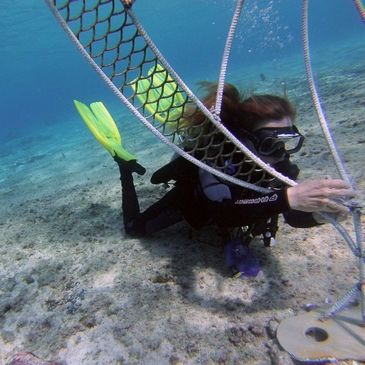
Komang Astika and Made find the location in Karang Lestari (Coral Protection Project).  The small sculpture will cement itself to the sandy seafloor.